
Let me tell you about the worst month of my career. We had just landed a huge contract—500,000 LED modules for a major outdoor signage project. The customer wanted delivery in eight weeks. I was confident. We had a brand new, top-of-the-line general-purpose electronic led chip mounter that cost over $350,000. It could place any component, any package, any size. What could possibly go wrong?
Everything.
The first problem: speed. Our general-purpose mounter was rated for 60,000 components per hour—on paper. But that rating assumed small passives (0402 resistors) on a simple board with few component changes. Our LED boards had 1,200 LEDs each, and we had to switch feeders constantly. Real-world speed? Barely 18,000 components per hour. At that rate, we'd need six months to complete the order.
The second problem: LED handling. LEDs are more delicate than standard components. They have exposed lenses, sensitive phosphor layers, and specific polarity orientation. Our mounter's vacuum nozzle, designed for standard ICs, was scratching the lens surface on about 3% of the LEDs. The scratches weren't visible under normal lighting, but they created light scattering that reduced brightness by 10-15%. The customer noticed immediately.
The third problem: changeovers. Every time we switched between different LED types—different sizes, different colors—we had to reconfigure the nozzle, recalibrate the vision system, and reprogram the placement sequence. Each changeover took 2-3 hours. We had six LED types on this project. The changeover time alone consumed an entire shift every day.
I remember standing in front of that machine on a Friday evening, watching it place LEDs one by one, painfully slowly, while the customer was calling asking for delivery updates. I thought: "There has to be a better way."
That's when I started researching dedicated electronic led chip mounter systems. And what I found changed how I think about SMT line design forever.
What Makes a Dedicated LED Mounter Different from a General-Purpose Mounter?
Before I get into the specifics, let me clarify a fundamental distinction. There are "universal" or "general-purpose" chip mounters that can handle resistors, capacitors, ICs, connectors, and yes, LEDs. Then there are dedicated electronic led chip mounter systems that are specifically engineered for LED assembly.
The difference isn't just marketing. It's in the DNA of the machine.
Speed-Optimized Architecture
A general-purpose mounter has to be flexible. It has to handle tiny 0201 passives and huge BGA packages. This flexibility comes at a speed cost—the head moves slower, the vision system has to accommodate more component types, and the software is more complex.
A dedicated electronic led chip mounter is built for one thing: placing LEDs, fast. The head travels at up to 2.5 meters per second. The acceleration is higher. The vision system is optimized for LED packages—it recognizes the unique features of LEDs (lens, cathode marking, phosphor pattern) and doesn't waste time analyzing components it will never encounter.
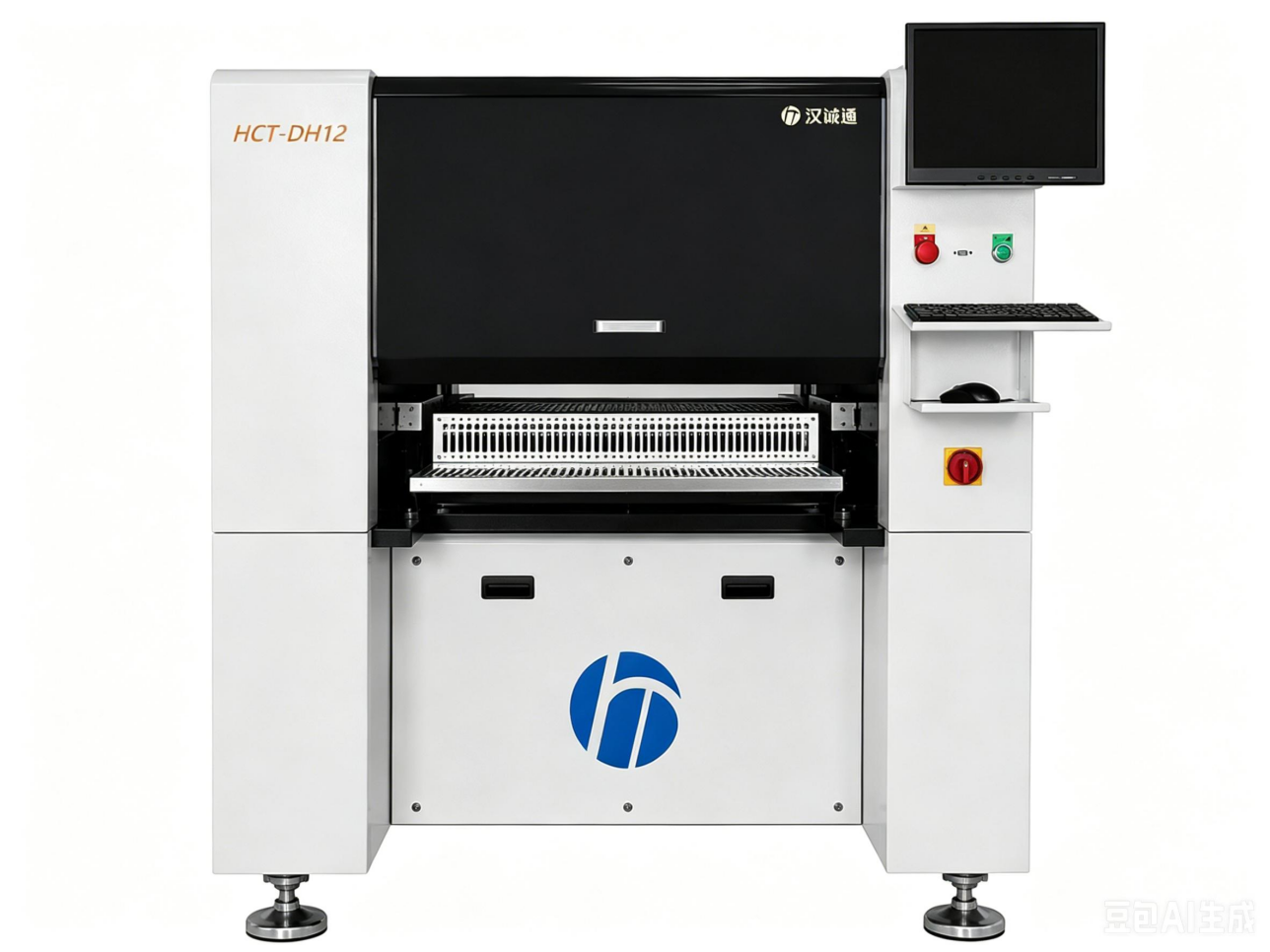
Our Shenzhen HanChengTong Technology Co., Ltd electronic led chip mounter runs at 80,000 components per hour in actual production conditions. That's not a paper spec—that's what we actually achieve. And we've pushed it higher with some optimization.
LED-Specific Handling
LEDs have handling requirements that standard components don't. Here are three specific features our electronic led chip mounter has that our general-purpose mounter lacked:
- Gentle Nozzle Design: The nozzle has a compliant tip with a soft rubber pad that contacts the LED lens without scratching it. The vacuum pressure is lower—just enough to lift the LED, not enough to crack the fragile substrate.
- Polarity Detection: LEDs have specific polarity (anode and cathode). Installing them backward is a common defect, and one that's not always visible. The vision system on the electronic led chip mounter specifically checks for the cathode marking—usually a tiny dot or notch on the package. If the LED is rotated incorrectly, the mounter rejects it before placement.
- Pick-and-Place Reliability: LEDs often have uneven surfaces due to the phosphor coating. The mounter's vacuum detection system checks that the LED is correctly seated on the nozzle before it moves to the placement position. If the vacuum pressure is unstable—indicating the LED is tilted or damaged—the machine discards it and tries again.
Color and Bin Management
This is a feature I didn't even know I needed until we started using it. LEDs from the same manufacturer can have color and brightness variations (called "bins"). For applications where uniformity matters—like display screens or lighting panels—you need to place LEDs from the same bin together.
Our Shenzhen HanChengTong Technology Co., Ltd electronic led chip mounter has a bin management system. The feeder knows which bin each reel contains. The placement software can group LEDs by bin and assign them to specific positions on the board. For our premium lighting products, we use this to ensure that every panel has uniform color temperature.
The general-purpose mounter had no such capability. We used to manually sort LEDs by bin before loading them into the feeder—a slow and error-prone process. Now the mounter does it automatically.
Speed vs. Accuracy: The Real-World Tradeoff
You might think that faster placement means less accuracy. That's true for some machines. But I've found that a properly designed electronic led chip mounter achieves high speed and high accuracy simultaneously. Here's how.
Dual-Head and Multi-Head Configurations
Our electronic led chip mounter has four independent placement heads. While one head is placing a component, the other heads are picking up the next set of LEDs. This parallel operation is the key to high throughput.
Each head has its own vacuum system and vision calibration. The machine simultaneously:
- Picks up LEDs from feeders (up to 4 at a time)
- Aligns and positions them using the vision system (parallel processing)
- Places them on the board (simultaneous placement)
The general-purpose mounter we had before was a single-head machine. It picked one component, aligned it, placed it, then went back for the next. The new electronic led chip mounter is essentially four machines working in parallel, controlled by the same software.
Flying Vision vs. Stationary Vision
I had to learn this distinction when evaluating mounters.
"Stationary vision" means the component is picked, moved to a fixed camera position, photographed, then moved to the placement position. This is accurate but slow.
"Flying vision" means the camera moves with the placement head, photographing the component as it travels to the placement position. Our electronic led chip mounter uses flying vision. The component is aligned during the travel time, so there's no pause for imaging. This alone saves about 0.5 seconds per component—which, at 80,000 components per hour, adds up to significant time savings.
The Accuracy Numbers
Our Shenzhen HanChengTong Technology Co., Ltd electronic led chip mounter has:
- Placement accuracy: ±0.02mm
- Placement repeatability: ±0.008mm
- Rotary accuracy: ±0.01°
Those numbers are better than our general-purpose mounter, even though the dedicated machine is twice as fast. The reason is that the LED-specific machine has tighter mechanical tolerances and a more rigid frame. The general-purpose mounter had to accommodate a wider range of component weights, which forced design compromises that reduced accuracy at the extremes.
The Integration Story: How the Mounter Talks to the Rest of the Line
The electronic led chip mounter doesn't operate in isolation. It's the centerpiece of the SMT line, but it relies on other machines to work effectively. Here's how our integration works.
Pre-Placement Data from the SMT Glue Dispenser
Remember the smt glue dispenser from the previous post? It sits just upstream of the mounter. The dispenser applies glue dots to the board before the components are placed. But here's the key insight: the mounter receives glue dot position data from the dispenser.
If the dispenser's glue dot is slightly off-center—maybe due to a momentary pressure fluctuation—the electronic led chip mounter adjusts its placement position to match the glue dot. This closed-loop coordination ensures that every component lands exactly on its glue dot, even when there's variation in the dispensing process.
We achieved this integration through the MES. The dispenser records every glue dot's actual position and sends that data to the mounter. The mounter uses that data as the target position for the component. The result: we've virtually eliminated misalignment between glue dots and components.
Post-Placement Data from the Double-Sided AOI
After the electronic led chip mounter places the components, the board goes through reflow soldering and then to the double-sided AOI. The AOI inspects every component and reports back to the mounter.
If the AOI detects that a specific component type is consistently mispositioned—say, a particular LED package is always shifted 0.03mm to the left—the mounter's software automatically adjusts the placement offset for that component. This is the "closed-loop feedback" that I mentioned in earlier posts.
We've been using this feedback system for about 10 months now. The mounter has self-corrected for 8 different placement drift issues before they could cause quality problems. Without the AOI integration, we would have had to manually detect and correct these drifts, which would have caused production stops.
Physical Integration with the LED SMD PCB Unloader
At the end of the line, the LED SMD PCB Unloader collects the finished boards. The unloader's speed must match the mounter's speed. If the unloader is slower than the mounter, boards stack up on the conveyor, blocking production.
We had this exact problem when we first installed the new electronic led chip mounter. The mounter was faster than the old unloader. We had to upgrade the unloader to match the mounter's throughput. Now both are synchronized through the MES—the mounter signals the unloader when a board is coming, and the unloader adjusts its timing accordingly.
Real-World Throughput Numbers: How We Doubled Production
Let me give you concrete numbers from our actual production. These are not theoretical—they're from our daily production reports.
Before (General-Purpose Mounter):
- Components per hour: 18,000 (actual, not spec)
- Boards per hour: 15 (each board has 1,200 LEDs)
- Changeover time: 2.5 hours average
- Yield: 97.2% (defects from scratches, misplacements)
- Daily output (20-hour shift): 300 boards
After (Shenzhen HanChengTong Technology Co., Ltd Electronic LED Chip Mounter):
- Components per hour: 80,000 (actual, sustained)
- Boards per hour: 66 (1,200 LEDs per board)
- Changeover time: 12 minutes average
- Yield: 99.6% (defects almost eliminated)
- Daily output (20-hour shift): 1,320 boards
That's a 4.4x increase in output from the same line—just by replacing the mounter. And the yield improvement means we're spending far less on rework.
Let me put this in financial terms. That 500,000-board contract I was worried about? We completed it in 6 weeks instead of the 8 weeks we had. We delivered early, the customer was thrilled, and we won two more contracts from them as a result.
The electronic led chip mounter cost us about $80,000 more than the general-purpose mounter we might have bought instead. The payback period was 3.2 months. Yes, months. That's the fastest ROI I've ever seen on a capital equipment purchase.
The Feeder System: The Overlooked Bottleneck
When we talk about placement speed, most people think about the head movement. But in real production, the feeder system is often the actual bottleneck.
The electronic led chip mounter has a feeder system designed specifically for LED reels. Here's what makes it different:
High-Capacity Feeders
LEDs are often supplied on reels with thousands of components. Our general-purpose mounter's feeders held about 500 LEDs per feeder. We had to change feeders constantly. The new electronic led chip mounter has feeders that hold 5,000 LEDs each. That's 10x the capacity. We run an entire shift without changing any feeder.
Dual-Feeder Configuration
The mounter has two feeder banks. While one bank is in use, the operator can prepare the other bank for the next job. Changeovers are instant—just slide one bank out and the other in. This is why our changeover time dropped from 2.5 hours to 12 minutes.
Smart Feeder Recognition
Each feeder has an RFID tag. The mounter reads the tag and automatically knows:
- Which LED type is in the feeder
- How many LEDs remain
- Which bin (color/brightness) the LEDs belong to
This eliminates operator errors in loading the wrong LEDs. We used to have issues where an operator would load the wrong reel by mistake—happened about once a month. Since we got the new feeders, it's happened zero times.
Tape Cutting and Splicing
The electronic led chip mounter has an automatic tape cutting and splicing system. When one reel runs out, the mounter splices the next reel onto the tape without stopping. This is seamless—the operator doesn't even need to be nearby. The old mounter required manual splicing, which took about 3 minutes per reel and caused constant start-stop inefficiency.
LED-Specific Challenges That General Mounters Can't Handle
I want to be very clear about why you can't just "get by" with a general-purpose mounter for LED assembly. Here are four LED-specific challenges that our electronic led chip mounter handles easily, while our general-purpose mounter struggled.
Challenge 1: Lens Damage
LEDs have soft, often dome-shaped lenses. The vacuum nozzle on a general-purpose mounter is designed for flat IC surfaces. It creates a concentrated vacuum force on a small area of the lens, which can:
- Leave a suction mark (visible under magnification)
- Create stress fractures in the lens (invisible but cause light scattering)
- Displace the phosphor coating (changes color temperature)
The dedicated electronic led chip mounter has a nozzle with a large contact area and low vacuum pressure. It distributes the force evenly across the entire lens, preventing damage. Our lens damage rate dropped from 3% to essentially zero.
Challenge 2: Polarity Detection
LEDs are polarized. Install them backward, and they won't light. Simple, right? But the cathode mark on an LED package is small—often just a tiny dot on one corner. In a high-speed mounter, the camera must detect that mark reliably, even with variations in lighting, package color, and board warpage.
The electronic led chip mounter has specialized vision algorithms that specifically look for LED polarity marks. It knows exactly where the mark should be based on the package geometry. The general-purpose mounter had a generic pattern recognition system that often confused the cathode mark with other package features.
Challenge 3: Height Variation
LEDs from different batches can have height variation of up to 0.1mm. On some packages, the phosphor layer thickness varies. When placing LEDs on a board, the mounter must compensate for these height variations to ensure consistent pressure on the solder paste.
Our electronic led chip mounter has a laser height sensor on each placement head. It measures the LED's height just before placement and adjusts the Z-axis motion accordingly. The general-purpose mounter had no such capability—it assumed all components were the same height.
Challenge 4: Thermal Sensitivity
LEDs generate heat during operation. This means they expand slightly after being turned on. For some high-power LEDs, the expansion is enough to create stress on solder joints if the LED was placed too tightly to the board.
The electronic led chip mounter has a temperature sensor on the placement head. It adjusts the placement force based on the LED's surface temperature—warmer LEDs get slightly less pressure to prevent over-compression. This is a level of detail that the general-purpose mounter simply couldn't handle.
Maintenance and Reliability: What I've Learned
A fast mounter is useless if it's broken all the time. Here's what I've learned about keeping our electronic led chip mounter running.
Preventive Maintenance Schedule
Our Shenzhen HanChengTong Technology Co., Ltd machine has a built-in maintenance log:
- Daily: Clean the nozzles, check vacuum pressure, run a test pattern
- Weekly: Clean the vision system lenses, check the feeder rails
- Monthly: Lubricate the motion axes, check the belt tension, recalibrate the camera
- Quarterly: Replace the filters on the vacuum system, check the motor brushes
- Annually: Full calibration by the manufacturer's service team
We follow this religiously. The machine has been running 20 hours a day, 6 days a week for 14 months. Total unscheduled downtime: less than 6 hours. That's a reliability rate of 99.9%.
Common Failures and Fixes
Here are the three most common issues we've encountered and how we resolved them:
Nozzle Blockage: Sometimes flux residue or dust blocks the vacuum nozzle. The electronic led chip mounter has an automatic nozzle cleaning station. Every 5,000 placements, the head moves to the cleaning station, a brush wipes the nozzle, and compressed air blows out any debris. We've reduced clogged nozzle issues by about 90% with this system.
Feeder Tape Slippage: Occasionally the tape that carries the LEDs slips in the feeder, causing a pick-up error. The mounter's tape feed system has a feedback sensor that detects the sprocket hole position. If the tape slips, the mounter adjusts the feed distance automatically. We haven't had a tape slip in 6 months.
Vision Drift: Over time, the camera can drift slightly due to temperature changes or vibration. The mounter has an auto-calibration routine that it runs every hour. It places a known reference component, checks the position, and recalculates the calibration parameters. This keeps the placement accuracy consistent regardless of environmental changes.
Spare Parts Strategy
We maintain a spare parts inventory for the electronic led chip mounter. The critical items are:
- Nozzles (always have 20 spares—they cost $15 each, cheap insurance)
- Vacuum filters (replace monthly)
- Feeder rollers (replace every 500,000 cycles)
- Camera lamps (replace every 10,000 hours)
Shenzhen HanChengTong Technology Co., Ltd has a regional warehouse, so we can get parts within 24 hours. We've never had to wait more than 2 days for any part.
The Operator Experience: Not Just About Speed
I talked to our operators about the new electronic led chip mounter. Their feedback was interesting—speed was a benefit for the company, but for them, the benefits were different.
Less Noise
The electronic led chip mounter is significantly quieter than the general-purpose machine. It runs at about 70 dB, while the old machine was over 85 dB. Our operators work 10-hour shifts. The noise reduction has noticeably reduced their fatigue.
Easier Setup
The machine has a large touchscreen interface with intuitive menus. Programming a new board takes about 20 minutes. Our operators, who aren't engineers, can handle basic setup tasks without calling a supervisor.
Fewer Alarms
The old mounter would alarm about 30 times per shift for minor issues—component misalignment, tape breakage, vacuum errors. Each alarm required an operator to acknowledge and reset the machine. The new electronic led chip mounter alarms about 3 times per shift. The operators are much less stressed.
Better Troubleshooting Tools
When there is an issue, the machine provides detailed diagnostics. It shows exactly which component failed, at what position, and why. The operator can fix most issues quickly without waiting for an engineer.
Conclusion: Why I Will Never Use a General-Purpose Mounter for LEDs Again
The electronic led chip mounter completely transformed our LED production line. What used to be a bottleneck—the placement step—is now the fastest part of our process. We've quadrupled output, improved yield, reduced rework, and delivered better quality to our customers.
But the most important outcome isn't about speed or efficiency. It's about reliability. We ship thousands of LED modules every week now, and we rarely have placement-related failures. Our customers trust us because their products work consistently.
If you're producing LED modules, LED strips, LED displays, or any LED-based product, do yourself a favor: buy a dedicated electronic led chip mounter. Don't try to cut corners with a general-purpose machine. The speed, quality, and reliability improvements are well worth the investment.
Our Shenzhen HanChengTong Technology Co., Ltd electronic led chip mounter has been running for 14 months. It's placed over 12 million LEDs. It has made us faster, better, and more profitable. I can't imagine going back.
FAQ (Real Questions from Real Production Managers)
Q1: How fast can an electronic LED chip mounter really go in actual production?
A: Our Shenzhen HanChengTong Technology Co., Ltd machine runs at 80,000 components per hour on our LED boards. The spec says 85,000, and we're within 6% of that. This is actual production speed, not lab conditions. The limiting factor now is our conveyor, not the mounter.
Q2: Can the electronic LED chip mounter handle different LED types?
A: Yes. We run five different LED packages on ours—from tiny 1.6mm × 0.8mm SMD LEDs to 5mm × 5mm high-power LEDs. The machine has quick-change nozzles for each type, and the vision system automatically recognizes the package. Changeover between LED types takes about 15 minutes.
Q3: How does the electronic LED chip mounter compare to a general-purpose mounter in price?
A: A dedicated electronic led chip mounter is typically 20-30% more expensive than a general-purpose mounter with similar throughput. Our Shenzhen HanChengTong Technology Co., Ltd unit cost about $380,000, while a comparable general-purpose machine was around $320,000. The price difference paid for itself in 4 months through increased output and reduced defects.
Q4: Does the electronic LED chip mounter require special training to operate?
A: Basic operation takes about 2 days of training. Advanced programming takes another week. Shenzhen HanChengTong Technology Co., Ltd provided onsite training for four of our engineers. After 10 months, one of them can handle 90% of issues independently. For the remaining 10%, we get remote support from the supplier.
Q5: Can the electronic LED chip mounter work with my existing feeders?
A: Probably not. The feeders for LED reels are specialized. Our machine uses Shenzhen HanChengTong Technology Co., Ltd's own feeder design, which has much higher capacity and more features than standard feeders. You'll likely need to buy new feeders with the mounter.
Q6: What's the typical maintenance cost for an electronic LED chip mounter?
A: We budget about $800 per month for maintenance—spare nozzles, filters, cleaning supplies, and the annual calibration service. This is about 20% lower than what we spent on the general-purpose mounter because the LED-specific machine is more reliable and has fewer breakdowns.
Q7: Can the electronic LED chip mounter place other components besides LEDs?
A: Yes, but that's not its primary strength. Our machine can place resistors, capacitors, and small ICs if needed. But for those components, the speed advantage isn't as significant. We use a separate general-purpose mounter for non-LED components on hybrid boards.
Q8: What's the biggest mistake companies make when buying an electronic LED chip mounter?
A: Underestimating the feeder requirements. A fast mounter is useless without feeders that can keep up. Make sure your feeder capacity, speed, and reliability match the mounter's capabilities. We bought extra feeders upfront—it cost more, but it was worth it.