
The Night Shift Call That Changed My Mind About "Simple" Equipment
It was 2:30 AM on a Thursday when my phone rang. The night shift supervisor sounded stressed. "The unloader jammed again—third time this week. We've got boards stacked up on the conveyor and the reflow oven is about to shut down because there's nowhere to put them." I walked into the factory thirty minutes later, still in my jacket, and saw the mess firsthand. Thirty-seven finished LED boards sitting on a makeshift table, operators manually picking them off the conveyor and sliding them into magazine racks by hand. Every board was a risk—fingerprints, ESD damage, edge chipping.
That night I realized something uncomfortable: we had spent $600,000 on a high-speed electronic led chip mounter, another $80,000 on a premium smt glue dispenser, and maybe $120,000 on a double-sided AOI—but we were still trusting our finished LED SMD PCBs to a $3,000 unloader that failed every other shift.
This blog is for every production manager who thinks the unloader is "just a conveyor with a lift." It's not. I learned that the hard way. And I want to explain why the LED SMD PCB Unloader might actually be one of the most underrated pieces of equipment on your SMT floor.
What Exactly Does an LED SMD PCB Unloader Do?
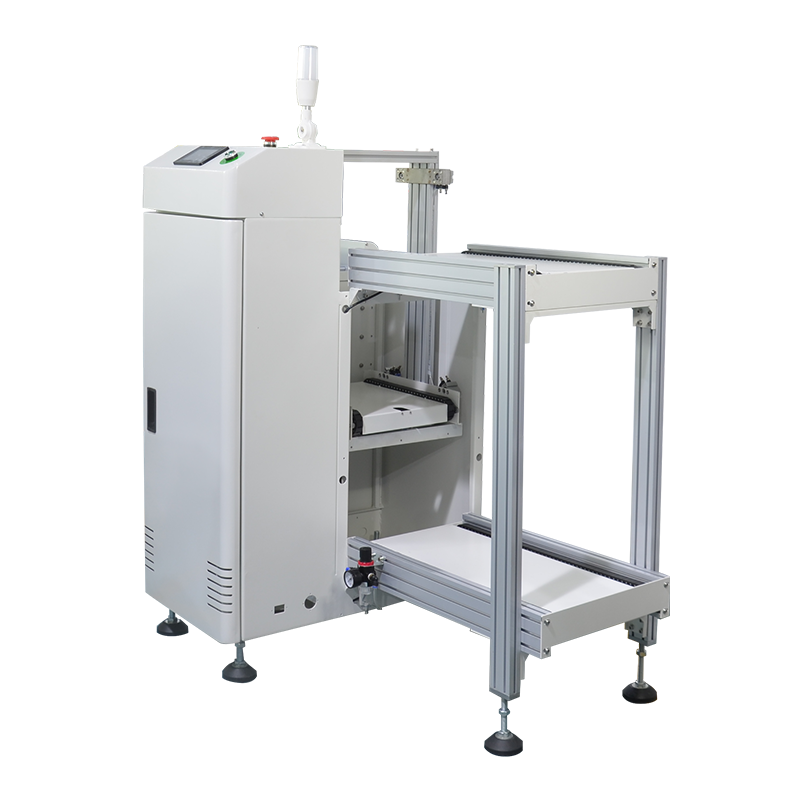
Let me start with the basics because I didn't fully understand this myself until I had to debug one at 3 AM. The LED SMD PCB Unloader sits at the very end of your SMT line, after the AOI or after the soldering oven. Its job sounds simple: take the finished boards off the conveyor and load them vertically into magazine racks. But here's what makes it specifically an LED SMD unloader:
- It handles boards that are often longer and narrower than standard PCBs (many LED strips are 300mm to 600mm long)
- It deals with boards that have fragile LED packages sticking up—some LEDs are 3mm to 5mm tall and can be crushed by improper handling
- It must accommodate high throughput—an LED line can easily push 200 to 300 boards per hour
- It needs static-safe handling because LEDs are electrostatic-sensitive devices
The LED SMD PCB Unloader bridges the gap between the automatic production process and manual storage or shipping. Without it, you'd have operators standing at the end of every line, catching boards like a human conveyor belt. That might work for low-volume prototyping. For real production? It's a disaster waiting to happen.
My Costly Lesson: Why I Stopped Buying "Cheap" Unloaders
When we first set up this LED production line two years ago, I made a classic mistake. I focused my budget on what I thought were the "important" machines: the electronic led chip mounter, the reflow oven, and the smt glue dispenser. When it came to the unloader, I told my procurement guy: "Just get something basic. It's just a loader and unloader—how complicated can it be?"
We bought the cheapest LED SMD PCB Unloader we could find. It was about $2,800. The sales guy promised it would handle our 500mm LED strips with "zero issues." That promise lasted exactly 11 days.
The first problem was alignment drift. The unloader's position sensors were cheap photoelectric switches that drifted out of calibration whenever the ambient temperature changed. Our factory isn't climate-controlled everywhere—it can get to 38°C near the reflow oven. The sensor drift caused the unloader to misalign the magazine rack by 2 to 3mm, which meant the board insertion mechanism would scrape the edges of the LED strips, chipping the solder mask and sometimes cracking the edge-mounted LEDs.
The second problem was ESD protection—or rather, the complete lack of it. The cheap unloader had no proper grounding, and its magazine racks were standard plastic with no static-dissipative properties. We started seeing ESD failures on our LED modules that we couldn't trace back to any other step. The electronic led chip mounter was perfectly fine. The smt glue dispenser was accurate. The AOI was catching everything it should. Eventually we traced the failures to the unloader—operators were handling boards right after they came off the unloader, and static charges were building up during the unloading process.
The third problem was throughput. The cheap LED SMD PCB Unloader took 8 seconds to complete each unloading cycle. That doesn't sound like much until you calculate it against a 200-board-per-hour mounter. Our electronic led chip mounter could place 220 boards per hour, but the unloader could only accept 180. That 40-board-per-hour gap created a bottleneck that forced us to run the mounter at reduced speed.
We replaced that unloader after four months. The new one from Shenzhen HanChengTong Technology Co., Ltd cost about four times as much. It was one of the best investment decisions I've made.
The Integration Reality: It's Not a Standalone Machine
Here's something I didn't appreciate until I had to reconfigure our entire end-of-line setup: the LED SMD PCB Unloader doesn't work in isolation. It's the final link in a chain that includes:
- The conveyor system that brings boards from the reflow oven
- The double-sided AOI that inspects boards and sends pass/fail signals to the unloader
- The magazine rack logistics—empty racks in, full racks out
- The MES or manufacturing execution system that tracks which boards go into which slots for traceability
Our new Shenzhen HanChengTong Technology Co., Ltd LED SMD PCB Unloader communicates directly with our double-sided AOI. Here's the workflow:
- Board comes out of the oven and enters the AOI inspection zone
- AOI inspects both sides and assigns a PASS or FAIL result to that board's serial number
- The board moves to the unloader
- The unloader reads the AOI result via SMEMA protocol
- PASS boards go into standard magazine slots; FAIL boards are ejected to a separate reject conveyor
That segregation is critical. Before we had this integration, FAIL boards would sometimes get mixed in with good boards because the operator didn't catch the AOI's visual alarm. The LED SMD PCB Unloader eliminated that human error entirely.
We also integrated the unloader with our inventory system. Each magazine rack has an RFID tag. When a rack is full, the unloader prints a label with the rack ID, board count, production date, and shift information. This label goes directly onto the rack. Our warehouse team can scan that label and immediately know everything about those 30 boards without opening a single ESD bag.
The LED-Specific Challenges That General Unloaders Can't Handle
I've had three different unloader models in my career—two "general purpose" units and one dedicated LED SMD PCB Unloader. The difference is night and day, and here's why.
Board Length and Flexibility
LED strips are often longer than standard PCBs. We run boards up to 600mm long. A general-purpose unloader with a 400mm maximum board size simply won't work. Even the ones that claim 500mm often have unstable support mechanisms for longer boards—they rely on edge guides that don't provide enough support in the middle, causing boards to sag during insertion.
Our Shenzhen HanChengTong Technology Co., Ltd LED SMD PCB Unloader uses a dual-support rail system with adjustable width control. The rails have rolling bearings that support the entire board length, preventing sag. This is especially important because many LED boards are thinner—0.8mm or 1.0mm FR4, compared to 1.6mm for standard PCBs.
Component Height and Fragility
LEDs—especially the newer COB (chip-on-board) and high-power types—can be 2mm to 5mm tall. Standard PCB components like resistors and capacitors are rarely over 1.2mm. The unloader's pusher mechanism must clear these tall components during insertion. We learned this the hard way. Our first cheap unloader had a pusher that traveled about 6mm above the board surface. That was fine for standard boards, but we had 4.5mm-tall LED modules with integrated lenses. The pusher actually scraped the tops off about 3% of the LEDs during unloading.
The LED SMD PCB Unloader from Shenzhen HanChengTong Technology Co., Ltd has a pusher height that's adjustable up to 12mm, with a sensor that automatically detects component height before starting the insertion stroke. The first time I saw that feature, I thought it was over-engineered. After losing two batches to scratched LEDs, I realized it was exactly what we needed.
ESD Considerations
LEDs are incredibly ESD-sensitive. A static discharge that wouldn't affect a resistor can permanently damage an LED chip, causing dimming, color shift, or complete failure. The LED SMD PCB Unloader must be fully ESD-compliant—grounded chassis, static-dissipative rails, conductive magazine racks, and ionization if needed.
Our current unloader is connected to a central grounding bus and has an integrated ionizing air blower that neutralizes static charges during board transfer. Since we added that, our ESD-related failure rate has dropped by about 70%.
Real Data: What Changed When We Upgraded
I keep detailed production records. Always have. So I can tell you exactly what happened when we replaced our cheap LED SMD PCB Unloader with a proper Shenzhen HanChengTong Technology Co., Ltd system.
Before (Cheap General-Purpose Unloader):
- Average downtime due to unloader jams: 47 minutes per shift
- Scratched or damaged boards from unloader: 1.2% of total production
- ESD-related failures at final test: 3.8% (we had to rework hundreds of boards)
- Magazine rack compatibility: limited to one standard rack type
- Throughput: 180 boards per hour max
- Total unloader-related quality loss: about $3,200 per month
After (Shenzhen HanChengTong Technology Co., Ltd LED SMD PCB Unloader):
- Average downtime due to unloader issues: 4 minutes per shift (mostly sensor cleaning)
- Damaged boards: 0.08%—and that's almost entirely from board flaws, not unloader handling
- ESD-related failures: 0.5%—and some of that is from other line sections
- Magazine rack compatibility: handles three different rack types with quick-change tooling
- Throughput: 260 boards per hour—we actually had to speed up the electronic led chip mounter to keep up
- Unloader-related cost savings: about $2,900 per month, plus we gained about 18 boards per hour in throughput
That's a 12-month payback period on the new unloader. Not bad for a piece of equipment most people ignore.
How the Unloader Interacts with Your AOI and Mounter
This is a point I want to emphasize because it's not obvious: the LED SMD PCB Unloader is the physical and data interface between your SMT line and the outside world.
Your electronic led chip mounter places components. Your smt glue dispenser applies adhesives. Your double-sided AOI inspects the results. But the unloader is what actually hands the finished product to your operators, your warehouse, your shipping department.
When the unloader receives a PASS signal from the AOI, it should place that board in the magazine in a way that maintains traceability. When the unloader receives a FAIL signal, it should handle that board differently—not just skip it, but separate it and create a record for rework.
Our Shenzhen HanChengTong Technology Co., Ltd LED SMD PCB Unloader does this through SMEMA and TCP/IP communication. The unloader receives real-time data from the AOI and matches it to the board's barcode or serial number. We also have a connection from the unloader back to the electronic led chip mounter's MES interface—if the unloader detects a misalignment or misfeed event that suggests a placement issue, it sends a warning back up the line.
That back-channel communication saved us once when the electronic led chip mounter developed a subtle vision offset that caused components to be placed about 0.2mm too far to the right. The AOI flagged it eventually, but the unloader noticed that boards were entering the magazine at a slight angle because the leading edge wasn't engaging the guide rails properly. That early warning allowed us to catch the issue 45 minutes before the AOI would have seen the cumulative effect.
The Magazine Rack Headache No One Warns You About
Let me complain about something that nobody mentioned during any of the sales presentations. Magazine racks are not universal. Different customers, different board types, different shipping requirements—they all demand different racks.
We use three main rack types:
- Standard 50-slot racks for most LED modules
- Deep-slot racks for boards with tall components (LEDs with integrated reflectors)
- Thin-profile racks for flex boards or very thin LED strips
Our old unloader could only handle the standard 50-slot racks. Switching to a different rack type required about 45 minutes of mechanical adjustment—changing guide widths, repositioning sensors, recalibrating the lift height. That's 45 minutes of downtime every time we needed to change rack types.
The Shenzhen HanChengTong Technology Co., Ltd LED SMD PCB Unloader has a quick-change tooling system. The side guides, pusher mechanism, and sensor positions are mounted on quick-release brackets. Switching racks takes about 4 minutes. The machine stores position presets for up to 10 rack types, so once the mechanical swap is done, the operator just selects the preset and the unloader reconfigures itself.
I know this sounds like a minor detail. But if you're running a high-mix production line, these 45-minute changeovers add up to real money. We calculated it: before the upgrade, rack changeover cost us about 10 hours of lost production per month. The quick-change system reduced that to about 45 minutes per month.
Maintenance Realities: What Actually Breaks
Every production manager knows that equipment maintenance is where the rubber meets the road. The spec sheet tells you one thing; reality tells you another. Here's what I've learned about keeping an LED SMD PCB Unloader running:
The Sensors Are Everything
Photo-interrupters and proximity sensors are the unloader's eyes. They tell the machine where the board is, where the rack is, and when to start and stop movements. Our old unloader used generic sensors that cost $12 each. They failed about once every two months. The Shenzhen HanChengTong Technology Co., Ltd unloader uses industrial-grade sensors that cost $45 each—but I haven't replaced a single one in 10 months.
The Rails Need Regular Cleaning
The guide rails accumulate dust and flux residue over time. On our cheap unloader, the rails had open bearings that trapped contamination. We had to disassemble and clean them every two weeks. The new unloader has sealed bearings and a self-cleaning rail system—the pusher mechanism actually wipes the rails with a felt pad during each cycle. We clean the rails monthly now, and it's mostly preventative rather than necessary.
The Belt Tension Drifts
The conveyor belts stretch. It's a fact of life. The old unloader required manual belt tension adjustment about every 800 hours of operation. The new one has an automatic tensioner. I didn't even know that existed until the Shenzhen HanChengTong Technology Co., Ltd engineer showed it to me during installation. The system monitors belt tension through current sensing on the motor and adjusts automatically. We haven't had a belt slip in 9 months.
The Software Is Never "Done"
The one thing I got wrong with the new unloader was thinking the software would be perfect out of the box. It wasn't. The first revision had a bug in the magazine counting algorithm that caused it to skip slot 17 every time. Shenzhen HanChengTong Technology Co., Ltd's engineers pushed a software patch within 48 hours. Since then, we've had three software updates—all improvements, all free, all remote-deployed. That's the kind of support I didn't get with the cheap unloader from a no-name supplier.
The Operator's Perspective (Not Just the Engineer's)
I talked to our operators about the new LED SMD PCB Unloader. Their feedback surprised me.
For the operators, the biggest improvement wasn't speed or accuracy—it was noise and stress. The old unloader would slam boards into racks, making loud mechanical noises that bothered operators standing nearby for 8-hour shifts. It would jam regularly, forcing the operator to stop what they were doing, walk to the end of the line, clear the jam, and restart. These interruptions were disruptive and tiring.
The Shenzhen HanChengTong Technology Co., Ltd unloader is quiet. The servo-driven movements are smooth and precise. Jams are extremely rare—maybe once every 2,000 cycles. The operator doesn't need to constantly monitor it. One of our operators told me: "I used to sit at the end of the line just waiting for the unloader to screw up. Now I can actually do my other jobs."
That's not a metric you'll find on any datasheet. But it matters. A calm operator is a careful operator.
Conclusion: Why I Now Start My Line Design with the Unloader
I've completely reversed my thinking on SMT line equipment prioritization. Before, I designed lines around the electronic led chip mounter and smt glue dispenser, treating the unloader as an afterthought. Now I start with the unloader and work backward.
Why? Because the unloader determines:
- How boards leave your line (damaged or intact)
- How boards are stored (ESD-safe or not)
- How boards are tracked (traceable or anonymous)
- How your operators feel at the end of their shift (frustrated or calm)
The LED SMD PCB Unloader is the last piece of equipment that touches your product before it reaches the customer's hands. If that last touch is careless, everything else you did—the perfect solder paste printing, the precise electronic led chip mounter placement, the accurate smt glue dispenser application, the thorough double-sided AOI inspection—is undermined.
If you're designing or upgrading an LED SMT line, I strongly recommend looking at a serious LED SMD PCB Unloader. The one from Shenzhen HanChengTong Technology Co., Ltd has performed better than I expected, and honestly, I expected a lot after the disaster of our first purchase.
It's not the most expensive machine on the line. It's not the most technically impressive. But it might be the one that saves you the most headaches.
FAQ (Real Questions from Real Production Managers)
Q1: Do I really need an LED-specific unloader, or will a general SMT unloader work?
A: If you're running LED boards longer than 300mm, with components taller than 2mm, or with any ESD-sensitive LEDs, get an LED-specific unloader. I tried the general one. I regretted it. The LED SMD PCB Unloader has the board support, height clearance, and ESD protection that generic units lack.
Q2: My line already has a conveyor. Can I just add an unloader at the end?
A: Yes—if your conveyor has the right interface. Our Shenzhen HanChengTong Technology Co., Ltd unit connected to our existing conveyor within a day. The physical connection requires matching conveyor height (typically 900±50mm for most SMT lines) and signal compatibility (SMEMA is the standard). Check both before you buy.
Q3: What's the cost difference between a cheap and a good unloader?
A: A cheap imported unloader might cost $2,500–$4,000. A solid LED SMD PCB Unloader from a brand like Shenzhen HanChengTong Technology Co., Ltd is typically $8,000–$12,000. The difference is in build quality, ESD protection, reliability, and support. If your line runs 20 hours a day, buy the good one.
Q4: How does the unloader handle our AOI's reject decisions?
A: The unloader should accept digital signals (pass/fail) from the AOI. Our LED SMD PCB Unloader has two output lanes—one for pass boards (going into magazine racks) and one for fail boards (ejected to a reject bin). Make sure your unloader supports this segregation. Some cheap units don't, which means you'll be manually separating good and bad boards later.
Q5: Can the LED SMD PCB Unloader handle boards with stiffeners or metal cores?
A: Yes, within the weight capacity. Our unit handles boards up to 3kg with additional support. If you're running heavy aluminum-backed LED boards, confirm the maximum board weight with the supplier. The Shenzhen HanChengTong Technology Co., Ltd unit supports up to 2.5kg standard, with heavier-duty options available.
Q6: Do magazine racks come with the unloader, or do I need to buy them separately?
A: Usually unloaders come with 1–3 racks as samples. You'll need to buy additional racks separately. For an LED SMD PCB Unloader, make sure the racks are ESD-safe and compatible with your board length and thickness. We bought 60 additional racks from Shenzhen HanChengTong Technology Co., Ltd and they've lasted two years without warping.
Q7: How long does installation take?
A: For a straightforward installation on a standard conveyor, count on 1–2 days. Our Shenzhen HanChengTong Technology Co., Ltd unit was installed in 6 hours, with another 4 hours of training for our operators and maintenance team. We had the line running at full speed the next day.
Q8: What's the biggest mistake people make with unloaders?
A: Buying based only on price, which I did. The LED SMD PCB Unloader is the last thing that handles your product. If it damages boards, scuffs LEDs, or introduces static, you lose all the quality you built upstream. Spend the extra money. Get the right tool. I learned that lesson the hard way and I'm sharing it so you don't have to go through the same pain.